

 InfoSearched
A spine surgeon takes a hard look at the internet’s favorite neck-crack.
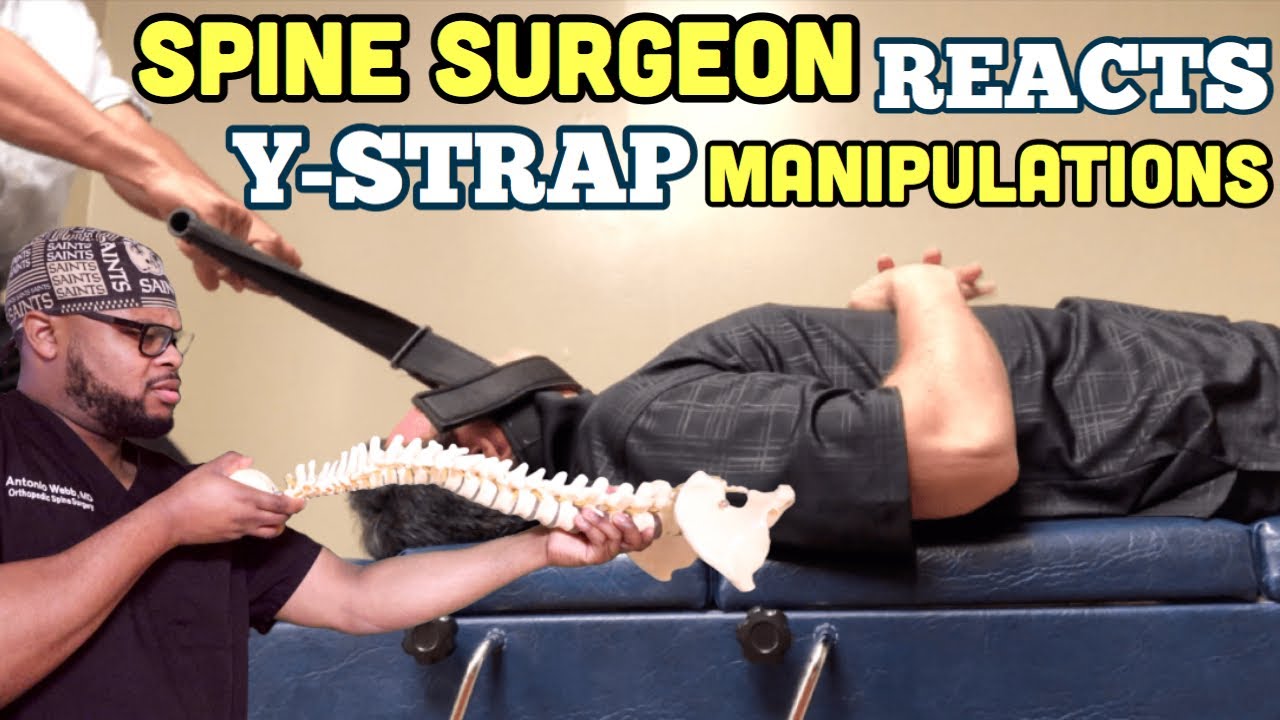
The Y-strap adjustment has been all over social media for a couple of years now — that sudden, audible pull that yanks a patient’s head back and produces a satisfying crack that racks up millions of views. In his video “SPINE SURGEON reacts to Chiropractic Y-Strap Manipulations,” orthopedic spine surgeon Dr. Antonio J. Webb, M.D., pulls the technique apart frame by frame, weighing the biomechanics against what he sees on the operating table. His verdict isn’t a blanket condemnation, but it comes with a long list of caveats that anyone watching those viral clips probably hasn’t considered.
- Dr. Antonio J. Webb, M.D., an orthopedic spine surgeon, reviews popular online Y-strap demonstrations in “SPINE SURGEON reacts to Chiropractic Y-Strap Manipulations.”
- The Y-strap is fastened around the base of the skull and chin and delivers a high-velocity, low-amplitude — or in some cases high-amplitude — axial pull along the body’s vertical Y-axis, intended to decompress the cervical spine.
- Webb flags the lack of measurable force control behind the pull as his central concern, warning it can risk disc herniation, neurological deficits, or vertebral artery injury even as patients report relief.
The Mechanics of the Pull
The Y-strap itself is a simple piece of equipment — a strap looped around the chin and occiput, hooked to a handle the chiropractor uses to deliver a sharp axial traction pull. The idea, Webb explains, is to momentarily stretch and decompress the cervical vertebrae, opening up space around the discs and nerve roots the same way manual or mechanical traction has long been used in physical therapy. What separates the Y-strap from that traditional traction is speed: instead of a slow, sustained pull, it’s a rapid jerk along the spine’s vertical axis, which is exactly where Webb starts asking questions.
Traditional cervical traction devices used in clinical settings are calibrated — the applied force is measured in pounds and delivered gradually. A hands-on Y-strap pull carries no such gauge. It relies entirely on the practitioner’s feel for how much force to apply, which is where Webb’s surgical perspective diverges sharply from the chiropractic sales pitch built around these videos.
A Surgeon’s Read on the Risks
Watching the same demonstration clips that have racked up views across social media, Webb walks through what’s actually happening to the cervical ligaments, discs, and nerve roots during that split-second pull. He doesn’t dispute that some patients feel immediate relief from the stretch — plenty do — but he stresses that “relief” and “safety” aren’t the same measurement.
There’s no measurable force control on that pull — and along the cervical spine, that’s the margin between relief and a vertebral artery injury.
That’s the crux of his critique: without quantifiable force feedback, a technique that looks identical from patient to patient could be landing wildly different loads on the neck each time. Webb ties that variability directly to the more severe complications he’s flagged — disc herniation, neurological deficits, and vertebral artery injury — outcomes that go well beyond the soreness or stiffness a patient might expect from a routine adjustment.
Chiropractic Care Versus Surgical Intervention
Webb isn’t arguing that chiropractic care has no place in treating neck and back pain — plenty of his own patients have tried conservative therapies before ever landing in a surgeon’s office. What he’s drawing a line around is the specific combination of high-velocity axial force and the cervical spine’s dense cluster of nerves, arteries, and discs, a combination he treats far more cautiously than most viral demonstrations suggest. For readers managing chronic joint or spinal discomfort through non-surgical means, the same due-diligence mindset applies to any hands-on manipulation, including options covered in pieces like a heads up on turmeric as a natural treatment for arthritis — know exactly what a treatment is doing to the tissue before committing to it.
His broader point lands on triage: some spinal conditions genuinely need decompression achieved through surgery, with imaging, precise measurements, and controlled correction — not a strap and a quick pull. Anyone weighing conservative options alongside strength and mobility work for their neck and back can find lower-risk starting points among general fitness, workouts and exercise routines that build supporting muscle without betting on unmeasured force.
Webb’s video doesn’t call for banning Y-strap adjustments outright — it calls for patients to ask their chiropractor exactly how much force is behind that pull before they let anyone snap their neck back for a camera.








I Trained Like “The Rock” For 30 Days
What I Eat In A Day
Reasons To Stop Worrying (Break The Habit of Excessive Thinking)
What a sex worker can teach us about human connection | Nicole Emma
7 Signs You Are A Heyoka, The Most Powerful Empath