

 InfoSearched
A British Tai Chi teacher heads into the Wudang Mountains to learn what Qi actually is — and how to move it.
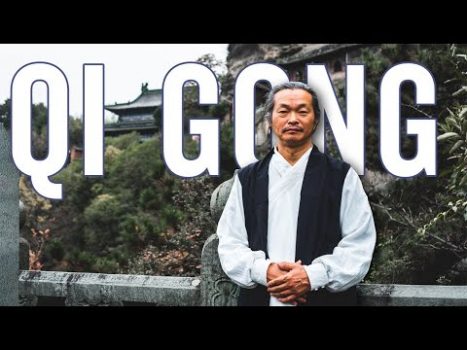
George Thompson didn’t set out to make a mystical explainer video. The British filmmaker and Tai Chi teacher traveled to China’s Wudang Mountains specifically to apprentice under Master Gu at the Wudang Taoist Wellness Academy, and “What is Qi Gong? Taoist Master explains power of Qi and philosophy” is the record of that apprenticeship. Rather than staging an academic lecture, Thompson lets Master Gu walk through Qi Gong the way it’s actually taught inside the lineage — as a practical, repeatable discipline, not an abstract concept.
- Master Gu breaks the term into its two parts: “Qi” as vital life force energy, and “Gong” as dedicated practice, cultivation, or skill built over time.
- The practice combines slow, fluid movement, breath regulation, mindfulness, and meditation to work the body’s meridians and align the practitioner with the Tao’s natural patterns.
- Thompson frames the video as an apprentice’s search for practical remedies to modern anxiety and disconnection, not a tourist’s curiosity piece.
Breaking Down Qi and Gong
Master Gu’s starting point is linguistic before it’s philosophical. Qi is the vital energy Taoist thought treats as the animating current running through the body and the natural world alike; Gong is the sustained work — the practice, cultivation, skill-building — that a person applies to that energy over years, not weeks. Put together, Qi Gong (sometimes rendered Chi Kung) describes a discipline of deliberately cultivating and directing that life force rather than leaving it to chance.
That framing matters because it separates Qi Gong from a fitness routine you master and move past. Master Gu treats it as an ongoing internal skill, closer to calligraphy or martial arts training than to a workout program with an endpoint.
Movement, Breath, and the Meridians
In the video, Master Gu demonstrates how the practice actually works: slow, deliberate movement paired with regulated breathing and a meditative, mindful attention. The goal is harmonizing the flow of energy through the body’s meridians — the same channels referenced throughout Chinese traditional medicine — so that Qi moves freely instead of stagnating.
None of it is built on strain. Master Gu is explicit that the exercises cultivate balance and relieve physical and mental tension without strenuous force, which is part of why Qi Gong shows up across age groups and fitness levels rather than being confined to athletes.
Qi is the life force, Gong is the practice — put them together and you get a discipline built on cultivation, not conquest.
A Cultural Bridge, Not a Seminar
What separates this video from a standard how-to clip is the relationship at its center. Thompson isn’t narrating from the outside — he’s Master Gu’s apprentice at Wudang, and the piece functions as a cultural bridge between a traditional Daoist lineage and a Western audience trying to make sense of anxiety, disconnection, and modern stress. That’s the same territory explored in TAOISM | The Art of Not Trying, where the Taoist idea of effortless action gets its own treatment.
Master Gu’s version of Qi Gong isn’t presented as a cure-all or a performance. It’s positioned as daily maintenance — the kind of practice meant to nurture both physical vitality and spiritual tranquility over a lifetime, echoing the internal-cultivation themes covered in TAOISM | The Fasting of the Heart (An Ultimate Detox).
Static, Dynamic, and Meditative Forms
The practice itself splits into recognizable categories that Master Gu touches on through demonstration: postures held to build and concentrate Qi, active movement sequences involving stretching, twisting, and bending, and quiet meditation used to settle the breath and the mind. Each form serves the same underlying aim — regulating Qi rather than forcing it — just through a different physical vehicle.
Thompson’s next stretch of footage from Wudang keeps following the same thread: an outsider apprenticing under a Taoist master, translating centuries-old internal practice into something a viewer with no background in Chinese philosophy can actually try in their own living room.
Can You Guess Her Age? — Raw Vegan Diet Is Woman’s Fountain of Youth
FASHION NOVA BUTT IMPLANT UNDERWEAR.. DO THEY WORK? | KASEY RAYTON
Best exercises to Lower blood pressure
Being Healthy Can Be Fun
An Athlete Squatted 500 Reps In 20 Minutes – This Is What Happened To His Kidneys