

 InfoSearched
Two CrossFit athletes step onto Austen Alexander’s turf to find out if gym PRs mean anything against Navy standards.
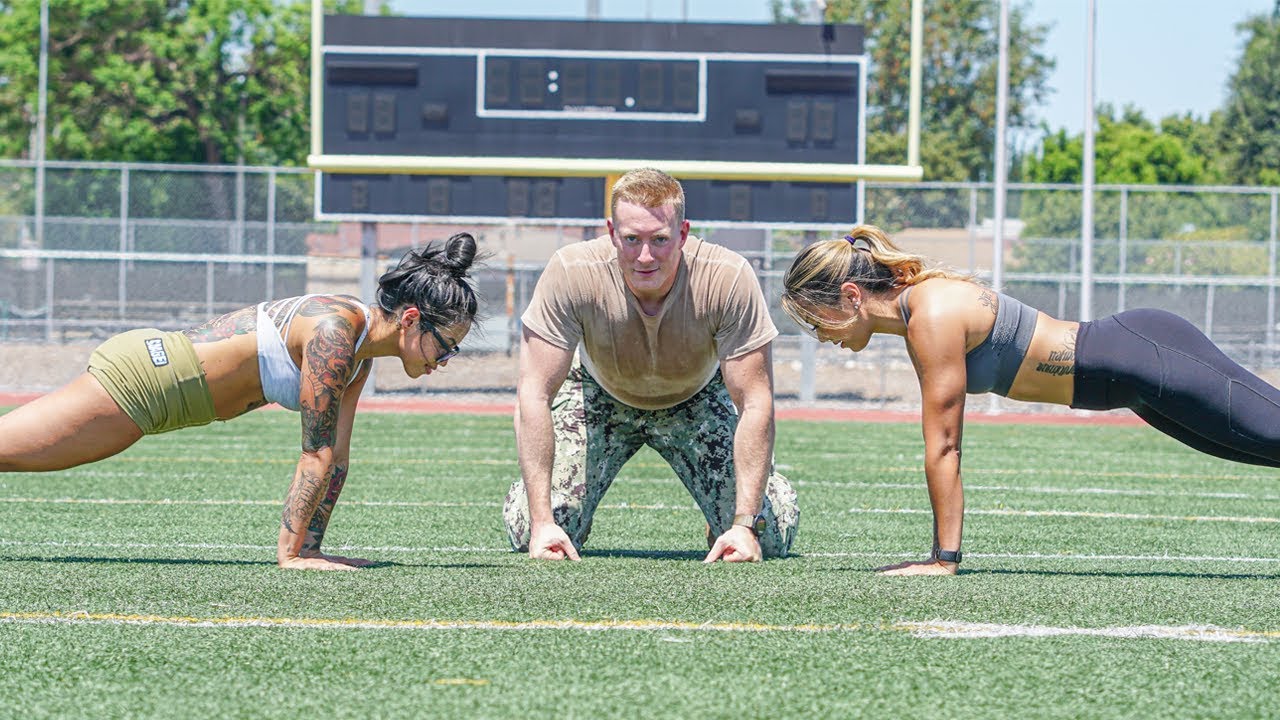
Active-duty sailor and fitness YouTuber Austen Alexander built his channel on a simple premise: take fitness cultures that think they’re tough and see how they hold up against actual military benchmarks. In “Crossfit Athletes Attempt the US Navy Physical Readiness Test,” he brings in two civilian CrossFit athletes and puts them through the real U.S. Navy PRT — scored the way the Navy scores it, not the way a CrossFit box would. The question isn’t whether they’re fit. It’s whether high-intensity functional training translates to the specific cadence and pacing the Navy demands.
- The PRT tested by Alexander covers three official components: a two-minute max push-up test, a two-minute max curl-up (sit-up) test, and a timed 1.5-mile run.
- Alexander graded both CrossFit athletes against official Navy age-group scoring charts rather than generic fitness standards.
- The video frames the run as the component where CrossFit’s power-and-stamina style clashes most with the Navy’s aerobic pacing requirements.
Two Different Fitness Cultures, One Test
CrossFit is built around constantly varied functional movements — Olympic lifts, gymnastics, sprints, rowing — performed at maximum intensity for short, brutal windows. The Navy PRT is built around something else entirely: sustainable, repeatable output that a sailor can produce twice a year for an entire career, scored on a fixed rubric with strict form standards. Alexander’s setup puts those two philosophies in the same room and asks a straightforward question: does a CrossFit athlete’s engine and strength carry over when the scoring becomes rigid and the movements get judged rep-by-rep?
That contrast is the entire premise of the video. It’s not a gym stress test — it’s a military one, with Alexander acting as the evaluator holding both athletes to the standard he lives by as an active-duty sailor.
Push-Ups and Curl-Ups Under Military Form Standards
The push-up and curl-up portions expose the first gap between the two disciplines. CrossFit athletes are used to grinding out reps under fatigue, but the Navy’s two-minute max tests are strict on form — full range of motion, proper cadence, no shortcuts that would pass in a WOD but get no-repped by a Navy evaluator. Alexander walks through the official age-group charts as he scores each athlete, showing exactly how a rep count converts into a Navy score rather than just a number on a whiteboard.
Readers looking to build baseline strength for tests like these can find useful cross-training approaches in 10 HIIT Exercises to Lose Belly Fat FASTER, which covers the kind of high-output intervals that overlap with both CrossFit and military conditioning work.
The 1.5-Mile Run Exposes the Pacing Gap
The run is where the video’s real drama plays out. CrossFit conditioning is built for unpredictable, varied efforts — not for locking into a steady, sustained pace over 1.5 miles. Alexander notes that this is consistently the component where CrossFit-trained athletes struggle most against Navy standards, since the test rewards even, controlled pacing rather than an all-out push followed by a fade.
The push-ups and curl-ups look like CrossFit. The run looks like the Navy — and that’s where the gap shows up.
Key Findings from the Comparison
Alexander’s evaluation isn’t about crowning a winner — it’s about showing viewers exactly where functional fitness training lines up with military fitness testing and where it doesn’t. Strength and short-burst conditioning transfer well. Sustained aerobic pacing under a fixed clock and a fixed scoring chart is a different skill, one the Navy has been testing sailors on for decades. Anyone building a training plan around the same goals — improving both power output and sustained endurance — will find relevant programming in How To Build Muscle And Lose Fat At The Same Time or in the broader Fitness, Workouts & Exercise archive.
Alexander’s channel has built a whole format out of exactly this kind of test — bringing in outside athletes, holding them to the actual standard he’s graded on as a sailor, and letting the scoring chart do the talking instead of a stopwatch bragging session. This video is another entry in that series, and it’s the run, not the push-ups or curl-ups, that ends up being the great equalizer.








Nikola Tesla Was Doing It Before Sleep! TRY IT TONIGHT!
The gentle power of highly sensitive people
Schizophrenic in 2020 (Coping with the Chaos)
Hooded Eyes Do’s & Don’ts!
20 MIN BOOTY WORKOUT // No Equipment | Pamela Reif