

 InfoSearched
Five minutes a day, one plank position, and a month-long case for rethinking your core routine.
Bright Side’s animated breakdown, “Plank Every Day for a Month, See What Happens to Your Body,” makes a simple pitch: skip the equipment, skip the gym membership, and hold a single static position for less than five minutes a day. The video walks through what actually happens inside the body when planking becomes a daily habit rather than an occasional add-on to a workout. It’s less about a dramatic before-and-after and more about the specific muscles, systems, and stress responses that respond to sustained isometric holds.
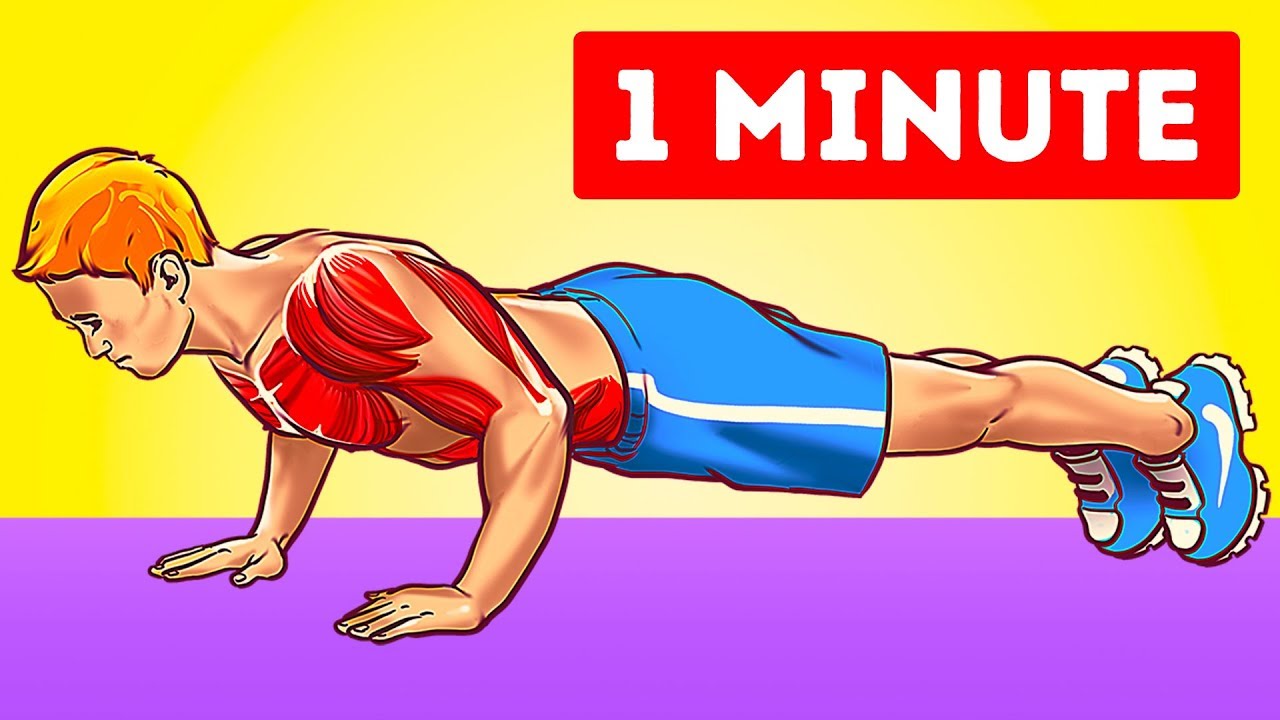
- The routine requires under five minutes per day and targets the rectus abdominis, transverse abdominis, obliques, and glutes to stabilize the spine.
- Daily planking is presented as burning more calories at rest than dynamic moves like sit-ups or crunches, because it recruits stabilizing muscles in the shoulders, biceps, quadriceps, and shins simultaneously.
- The static stretch involved is said to loosen tension-prone areas — neck, shoulders, back, hamstrings, shoulder blades, and foot arches — which the video ties to reduced physical stress when paired with steady breathing.
Plank Exercises Outperform Traditional Crunches
Bright Side’s core argument hinges on muscle recruitment, not repetitions. A crunch isolates the rectus abdominis through a short range of motion; a plank locks the rectus abdominis, transverse abdominis, obliques, and glutes into one continuous contraction while the shoulders, biceps, quadriceps, and shins work just to keep the body rigid. That’s the mechanism the video points to when it claims a plank burns more calories than sit-up-style movements — more muscle groups firing at once means a higher resting metabolic demand, even though nothing is technically “moving.” Readers looking to pair this logic with movement-based fat-burning work can cross-reference it against something like 10 HIIT Exercises to Lose Belly Fat FASTER, which attacks the same goal from the opposite end — high tempo instead of stillness.
The Posture and Pain Case
The video’s second pillar is spinal alignment. Because the plank forces the rectus abdominis and obliques to brace the spine in a neutral line, Bright Side argues that daily practice retrains posture by default — the body simply gets used to holding itself correctly. That matters most for anyone sitting at a desk for eight-plus hours, since a weak core is a documented contributor to both upper and lower back pain. The claim isn’t that planking cures back pain outright, but that a stronger stabilizing corset around the spine reduces the everyday strain that turns into chronic discomfort.
Under five minutes a day, one position, muscle groups from the shins to the shoulders working at once.
Flexibility and Balance as a Byproduct
Because the plank is a static hold rather than a repeated motion, Bright Side frames it as a stretching exercise in disguise. Holding the position lengthens the hamstrings, shoulder blades, and foot arches over time, which the video links to improved balance and general flexibility — benefits usually associated with yoga-style work rather than a core drill. That crossover is worth noting for anyone who already leans on mobility-focused routines; it’s the same logic behind flows built specifically around stretching and control, such as the approach in Yoga To Shift Perspective | 20 Minute Yoga Flow.
The Stress Argument
The final section of the video shifts from physical to psychological. Bright Side’s reasoning is that the neck, shoulders, and back are exactly where people carry tension when they’re stressed, and a plank — held correctly, with steady breathing — stretches those same muscles. The implication is that the daily discipline of holding a plank, breath under control, doubles as a short daily decompression, not unlike controlled-breathing practices used elsewhere in the fitness and wellness space.
For anyone skeptical that a single body-weight position can carry this much weight, it’s worth remembering the plank has a competitive extreme end too — the kind of territory covered in Longest plank EVER – Guinness World Records, where holds are measured in hours, not minutes. Bright Side’s 30-day pitch sits nowhere near that territory; it’s asking for under five minutes, once a day, for thirty days — the low end of the same exercise that, at its extreme, becomes a world record.






I FOLLOWED A MODEL’S ‘what I eat in a day’ VIDEO!!
30 Days of Alternate-Day Fasting – 10lbs of Body Fat (Before & After)
The Most PAINFUL Thing a Human Can Experience?? | Kidney Stones
Gordon Is Blown Away By Small Indian Restaurants Performance & Food | Ramsay’s Best Restaurant
TRY IT FOR 1 DAY! The Billionaires Do This Everyday!