

 InfoSearched
Visual Perception Reveals Cognitive Wiring
Bright Side’s “11 Optical Illusions That’ll Reveal Your Personality Type” takes a set of classic visual tricks — the kind cognitive science has used for over a century to study perception — and turns them into a rapid-fire self-assessment. The premise is simple: two people can stare at the exact same image and walk away with two different interpretations, and that split is treated as a window into whether someone leans analytical or intuitive, detail-driven or big-picture. None of the illusions are new inventions; what’s new is packaging them as a checklist viewers can run through in one sitting.
- The Spinning Dancer silhouette splits viewers into clockwise (logical, analytical) versus counterclockwise (creative, intuitive) camps.
- The Rubin Face-or-Vase illusion separates detail-first thinkers (who see the vase) from big-picture, socially oriented thinkers (who see the two profiles).
- The Necker Cube’s flipping orientation is used as a marker of cognitive flexibility and open-mindedness, while the Müller-Lyer illusion tests how susceptible someone is to outside influence.
The Logic-Versus-Intuition Split
The video opens with the Spinning Dancer, the rotating silhouette that’s been circulating online for over a decade because it genuinely can flip direction mid-stare without any change to the image itself. Bright Side frames clockwise rotation as a sign of a logical, analytical mind, while counterclockwise perception gets tagged as creative and intuitive. It’s the same bistable-perception trick that makes the Rubin Face-or-Vase illusion work — spot the vase first and the video calls you detail-oriented, spot the two facing profiles first and it calls you a big-picture, relationship-focused thinker.
The Necker Cube rounds out this opening trio. It’s a simple wireframe cube drawing that has no fixed front or back, so the brain keeps deciding which face is closest and then reversing itself. According to the video’s framing, people who notice the cube flipping quickly and repeatedly show more perceptual flexibility — read as a proxy for open-mindedness and adaptability in how they approach problems generally.
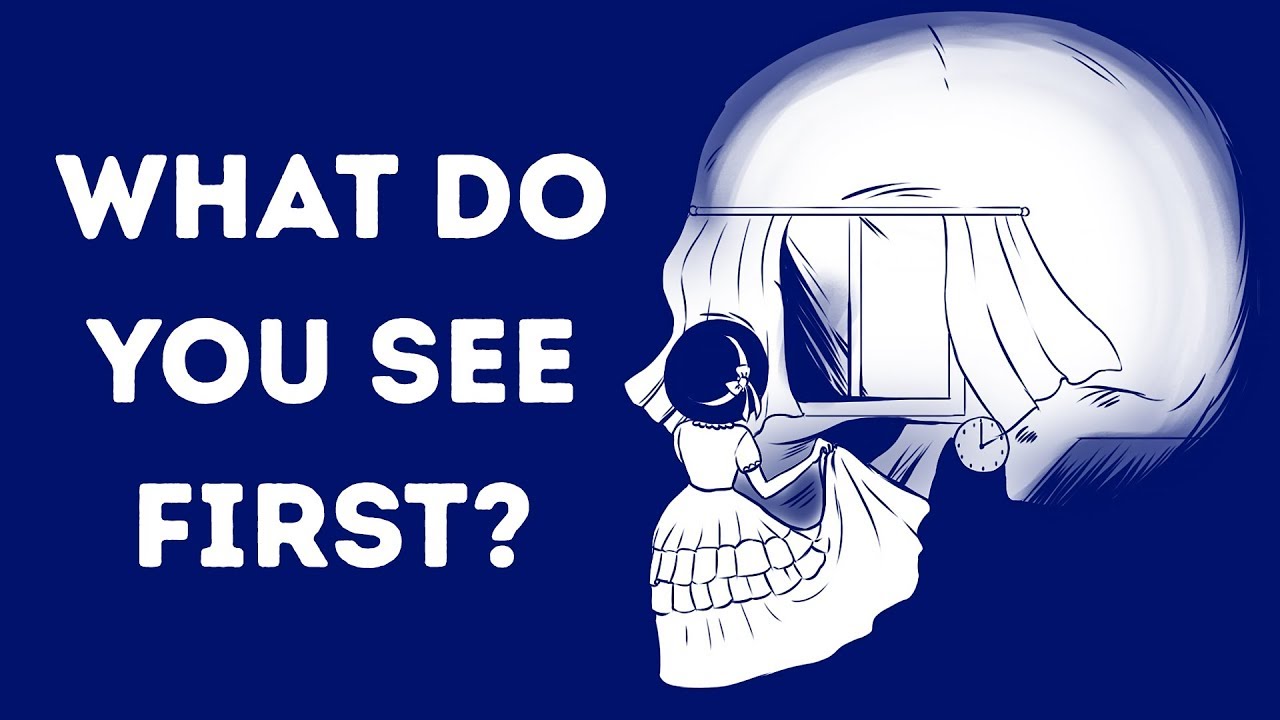
What you see first in such an image can speak volumes about your personality.
Illusions That Test Suggestibility
The Müller-Lyer illusion is the classic example here: two lines of identical length, one capped with inward-pointing arrowheads and the other with outward-pointing ones, and the outward-arrow line reliably looks longer even when a ruler proves otherwise. The video treats a strong reaction to this trick as a sign someone is more inclined to take advice from others and weigh outside input heavily.
That same theme runs through several other entries. The Ebbinghaus illusion — two identical circles that look different sizes depending on what’s surrounding them — gets tied to sensitivity to other people’s opinions. The Ponzo illusion, where converging lines make two equal-length segments look mismatched, is linked to how much someone is swayed by social norms. The Poggendorff illusion, an interrupted diagonal line that appears to misalign across a gap, gets read as a measure of how trusting someone is by default.
Mood, Nerves, and Optimism
The remaining illusions lean less on logic-versus-intuition and more on temperament. The Snake illusion — concentric rings that appear to slither when viewed peripherally — is framed as a marker of imagination for viewers who see it as fluid motion. The Zollner illusion, where straight lines look crooked because of overlapping diagonal strokes, gets tied to anxiety if the misalignment feels pronounced. The Hering illusion, two straight lines that appear to bow outward against a radiating background, is linked to a willingness to challenge authority, and the Fraser spiral — actually a series of concentric circles that the eye reads as a continuous spiral — closes the list as a stand-in for optimism when viewers see it as expanding outward.
Mechanisms Behind Visual Illusions
Every one of these images exploits a real, well-documented quirk of visual processing rather than any personality trait on its own — that’s the actual neurobiology behind bistable perception and contrast effects, and it’s identical for every viewer’s optic nerve. Bright Side’s spin is entertainment, not diagnostics, but it taps into the same appetite people have for quick self-assessment tools that pop up across the wellness space, from breakdowns on why introverts prefer solitude to lists of signs of a toxic personality. The format works because it hands viewers a low-stakes way to feel like they’ve learned something specific about themselves in under ten minutes.
Bright Side built its channel on exactly this kind of shareable, self-referential format, and the illusion list is a template the channel has leaned on repeatedly — swap in a different set of images and the same logical-versus-creative framing gets recycled for a new round of comments arguing about which way the dancer is actually spinning.







The Wrestler With No Legs
MUST DO TOTAL BODY 4MIN
4-Minute Workout That Replaces 1 Hour in the Gym
30-Minute No-Equipment Cardio and Core Workout With Massy Arias
10 Signs Your Kidneys Are In Trouble