

 InfoSearched
A late ethnobotanist’s voice, laid over ambient electronica, makes the case that you are not separate from the planet — you’re one of its cells.
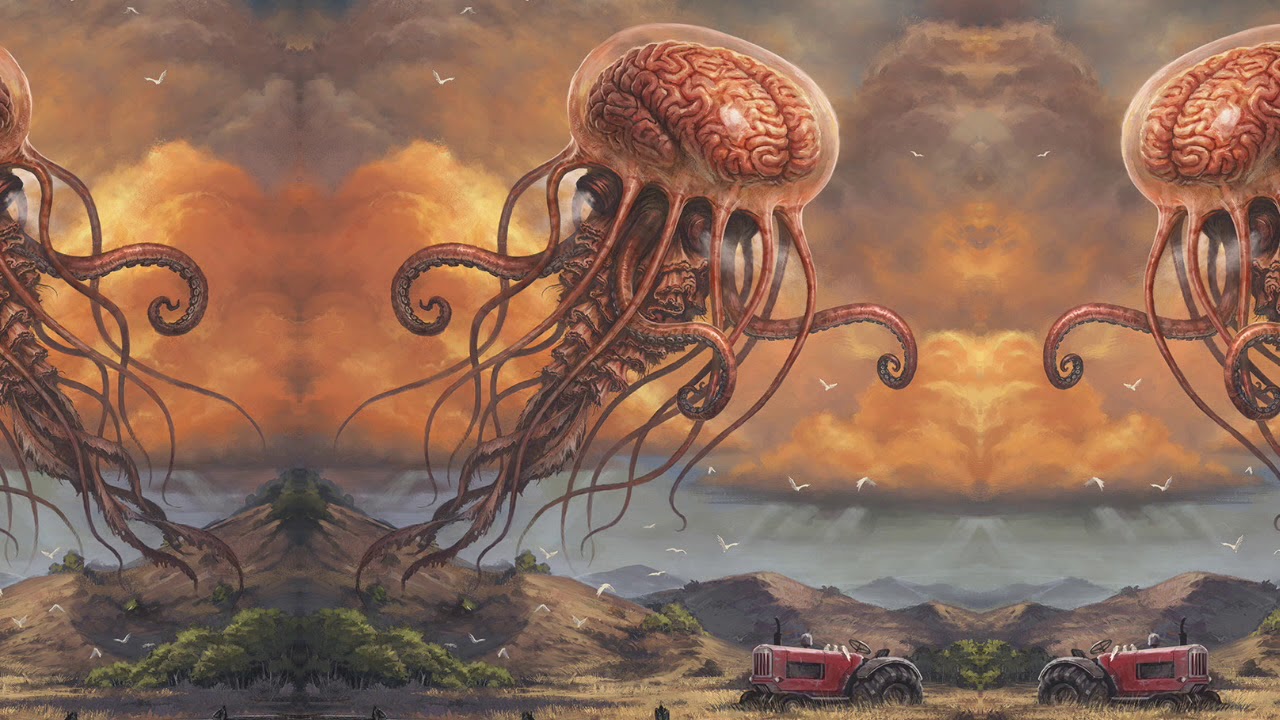
The video “Terence McKenna – We’re Inside A Larger Organism” pairs a recorded McKenna monologue with hypnotic visuals and a slow-building electronic score, the work of Hungarian producer Peter Bergmann, who releases this kind of material under the name We Plants Are Happy Plants. McKenna died in 2000, but his lectures — hours of them, recorded at conferences, bookstores, and workshops through the 1980s and ’90s — still circulate, and Bergmann has spent years cutting them into ambient tracks built for exactly this: sitting with an idea long enough to let it land.
The idea here is Gaia, but not the tidy textbook version. McKenna takes James Lovelock and Lynn Margulis’s model of Earth as a self-regulating organism and pushes it somewhere stranger — into synchronicity, coincidence, and the question of whether human consciousness itself is wired into that planetary system.
- The video is built from a Terence McKenna lecture recording, remixed and scored by Peter Bergmann (We Plants Are Happy Plants), a Hungarian producer known for turning McKenna’s talks into ambient psychedelic tracks.
- The Gaia hypothesis at the center of McKenna’s monologue was formulated in the 1970s by British scientist James Lovelock and microbiologist Lynn Margulis, who proposed Earth as a self-regulating system of living and non-living matter.
- McKenna extends the hypothesis past ecology into consciousness, arguing individual human lives function like cellular activity inside a larger planetary mind.
The Producer Behind the Sound
Peter Bergmann’s catalog under We Plants Are Happy Plants is almost entirely built on this formula: take a McKenna lecture, strip the audience noise, and set the voice against slow synth pads, field recordings, and kaleidoscopic footage of plants, cells, and cosmic imagery. It’s a niche corner of YouTube, but a durable one — McKenna’s talks were never scripted for music, yet his cadence, full of pauses and rhetorical turns, sits naturally over ambient production. “We’re Inside A Larger Organism” is one entry in that ongoing series, not a one-off.
Lovelock, Margulis, and the Original Gaia
The Gaia hypothesis McKenna is riffing on didn’t start as mysticism. Lovelock, working in the 1970s, proposed that Earth’s atmosphere, oceans, and biosphere behave as a single homeostatic system — one that regulates temperature, chemistry, and conditions for life the way a body regulates its own internal environment. Margulis, a microbiologist, helped develop the model further, grounding it in how microorganisms interact with and shape planetary chemistry. It was a scientific framework, controversial at the time, aimed at describing feedback loops between living things and the non-living systems around them.
McKenna’s Extension Into Mind
McKenna doesn’t stay in that lane. In the monologue, he takes Gaia past temperature regulation and carbon cycles and applies it to subjective experience — the coincidences, chance meetings, and oddly fulfilled wishes that make up a single human life. His argument is that these aren’t random; they’re evidence that individual minds are interfaced with something much larger, the way a cell doesn’t experience the whole organism but is still fully part of it.
“How is it that each of our lives is a work of art of unbelievable chance encounters, coincidences and wishes projected onto the world but never spoken and strangely fulfilled in the oddest ways?”
That question is the spine of the video. McKenna isn’t asking it rhetorically to move on — it’s the whole argument. If a life can be shaped by that many “coincidences,” he suggests, the simplest explanation might be that you’re not standing outside the system watching it happen. You’re inside it, doing what a cell does inside a body it can’t see the shape of. Readers chasing similar territory — how much of thought and identity is dictated by something bigger than the isolated self — will find overlapping ground in pieces like The Ego Is Betraying You From Being Your Genuine Self and Six Lies That Block Your Spiritual Awakening & Keep You Trapped In The Third Dimension.
McKenna never lived to see how far this specific talk would travel once producers like Bergmann started cutting it loose from its original lecture hall setting. The recording is decades old at this point, but the pairing with ambient visuals is what keeps pulling new listeners into a decades-old argument about whether “coincidence” is really just Gaia talking back.









10 Healthy Lunch Ideas For Weight Loss
“The Billionaire Algorithm” | (it will change your future!)
If You Struggle With Anxiety, This Mind Trick Will Change Your Life | Mel Robbins
The Future of Medicine
Why Japan Lives Longer