

 InfoSearched
A woodpecker shows up in this animation, and it’s supposed to be the thing wrecking your self-belief.
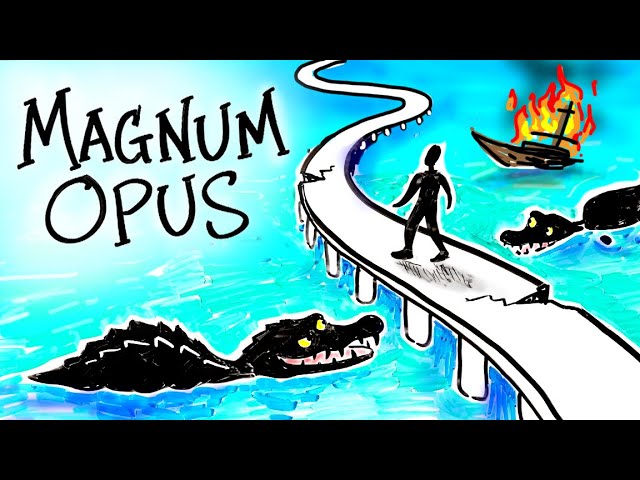
After Skool, the whiteboard-animation channel that’s built a following on turning heavy psychology and philosophy into digestible visual storytelling, tackles one of the oldest questions in “Magnum Opus – How to Find Your Purpose in Life”: why do so few people ever reach their ceiling? The video doesn’t blame the economy, the school system, or bad luck. It blames doubt, and it draws a picture to prove it.
- The video defines “magnum opus” — Latin for greatest work — as the peak intersection of talent, skill, and hard work realized at the right place and time.
- It argues doubt, not lack of talent, schooling, financial fear, or practicality, is the primary force that crushes ambition between childhood and adulthood.
- It illustrates self-belief as a tabletop held up by legs made of experience and evidence, with doubt animated as a woodpecker that chips away at those legs until the table collapses.
The Latin Term at the Heart of the Video
The video opens by grounding its whole argument in one phrase: magnum opus, someone’s greatest life achievement. It frames this as more than a career milestone — it’s the moment talent, developed skill, and sustained effort converge at exactly the right place and time. According to the narrative, everyone carries a version of this potential, whether it’s a book, an invention, a song, or an idea, but very few people ever let it fully surface.
It’s a setup that echoes themes explored elsewhere in this space, including how to know your life purpose in 5 minutes, which tackles the same “what am I actually here to do” question from a different angle.
Factors Behind Declining Childhood Ambition
Kids, the video points out, operate with the default assumption that anything is possible — no dream registers as too big. That assumption doesn’t survive contact with adulthood for most people, and After Skool spends real time ruling out the usual suspects: the school system, “realistic” expectations, financial anxiety, practicality. None of those, the video argues, are the actual killer. Doubt is.
That’s a deliberately narrower diagnosis than most self-help content offers, and it sets up the visual metaphor that carries the rest of the video.
The Tabletop and the Woodpecker
The video’s central image is mechanical and easy to picture: self-belief is a tabletop, and it only stays up because of legs made of concrete experience and reinforcing evidence. Doubt is animated as a woodpecker, pecking steadily at those legs. Enough pecking, and the table comes down — taking confidence with it.
The video pairs that image with a line borrowed from Buddha to make the same point in words instead of pictures.
We are what we think, all that we are arises with our thoughts. With our thoughts, we make the world.
The video’s argument is that attitude outweighs IQ when it comes to actually attempting the work — belief has to come before the evidence exists to support it, not after.
Rebuilding the Evidence
According to the video, reversing the woodpecker’s damage means deliberately moving toward beliefs that empower rather than shrink you, then hunting down role models, stories, and personal experiences that back up the new belief instead of the old doubt. Doubters, the narration warns, are usually people who never attempted the thing themselves — their input isn’t evidence, it’s noise.
The video closes with a practical exercise for viewers: write down what you love doing, what you’re good at, and what people will actually pay you for. The overlap of those three lists is the “sweet spot,” and After Skool’s pitch is that finding it — and then acting on it — is the whole game. For anyone chewing on the same territory, how to eliminate self doubt forever and the power of your unconscious mind picks up almost exactly where this video’s woodpecker metaphor leaves off.
The video never pretends the path is comfortable — it says outright that reaching a magnum opus means taking risks, sacrificing, and going the extra mile, with the payoff being the ability to look back at a short life and say you actually took the shot. That’s the whole pitch, delivered in a whiteboard sketch and a few minutes of narration, and it’s why the video keeps getting passed around on channels well beyond After Skool’s usual audience.







INSANE 7 MINUTE AT HOME WORKOUT
How to Burn the Most Fat
The Surprising Truth About Making Babies Late | Reisa Pollard | TEDxVancouver
LUNCH IDEAS FOR KIDS » vegan + healthy (bento box)
What Will Happen if You Eat 2 Bananas a Day